For an overseas company trying to build media visibility in China, press release distribution can look deceptively simple.
Choose a package. Submit a release. Select China as a target market. Receive a distribution report.
But the underlying distribution model can be very different from the way press release placement is commonly handled inside China.
The most important distinction is not simply global provider versus local provider.
It is the difference between distribution infrastructure and individual media placement.
Global newswires usually sell access to a distribution network
Traditional international newswires are designed around scale.
A company typically buys a package based on factors such as:
- number of press releases
- countries or regions
- industry targets
- word limits
- images and multimedia
- newsroom delivery
- syndication networks
- reporting features
EIN Presswire, for example, currently structures its plans around release credits, country and industry targets, and access to multiple distribution channels.
It lists distribution or placement through channels such as AP News, USA TODAY Network, Nexstar, Google News, Bloomberg Terminals, MuckRack and thousands of affinity publications. Several of these distribution paths are explicitly based on relevance.
The buyer is therefore primarily purchasing access to a distribution infrastructure.
The question is often:
How broadly can this release be distributed?
rather than:
Which exact media website will publish this article?
China often uses a media-by-media placement model
A common model in China works differently.
A media distribution provider may present a list of individual publishing options.
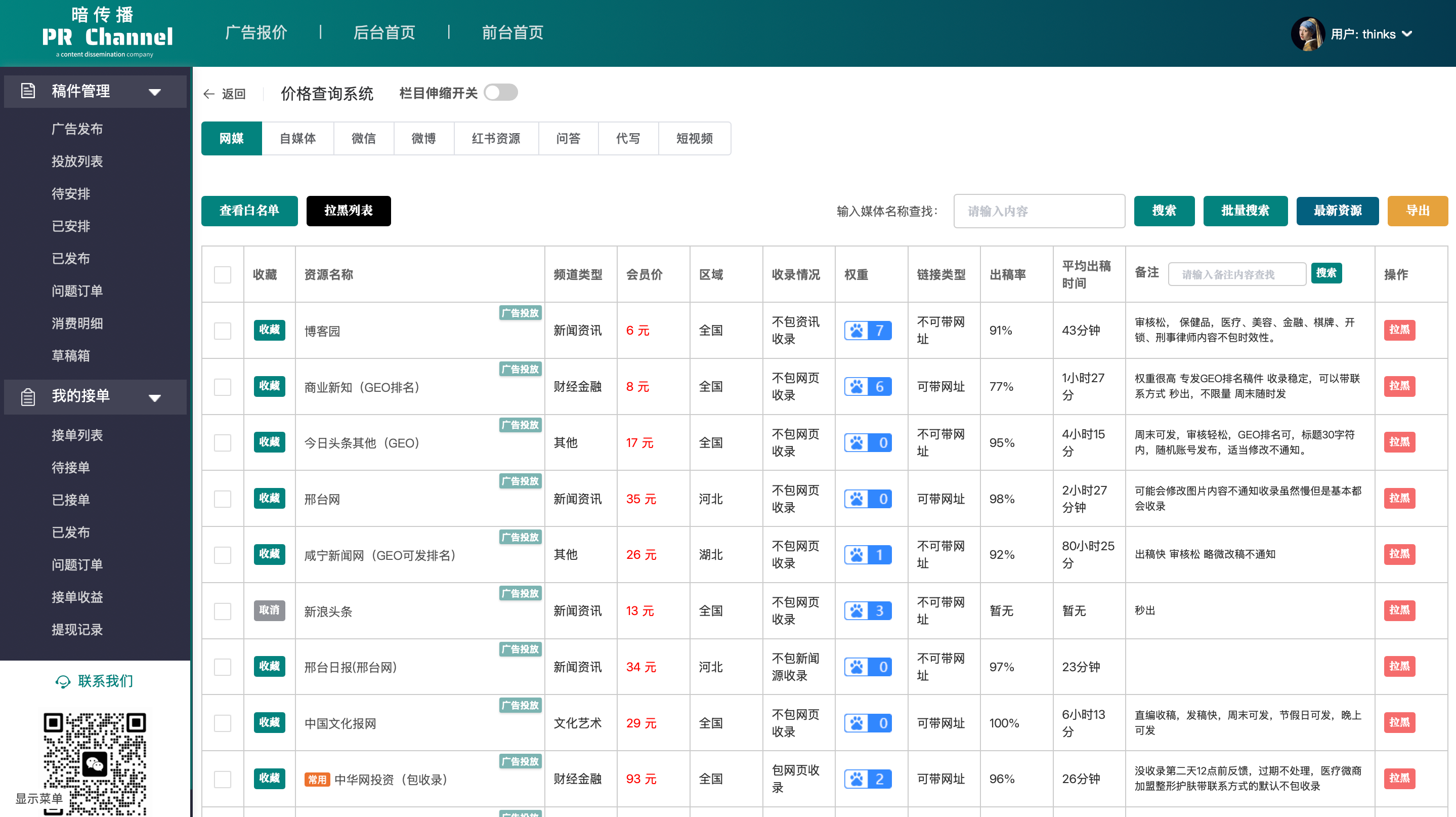
Each outlet may have its own:
- publishing price
- editorial requirements
- content restrictions
- turnaround time
- page type
- support conditions
The buyer may select individual media outlets before submission.
The process then looks more like:
- Select the media outlet.
- Review the publishing conditions.
- Submit the press release.
- Wait for editorial review.
- Receive the actual publishing URL if accepted.
This means the buyer is not only purchasing “distribution.”
The buyer is often purchasing an expected individual media placement.
“Distributed to” and “published by” are not the same thing
This distinction is particularly important when reading a newswire distribution report.
A service may say a release was:
- distributed to a media network
- delivered to journalists
- syndicated to partner sites
- fed into news aggregators
- made available through newsroom systems
- distributed based on relevance
These can all be legitimate distribution activities.
But they do not necessarily mean that a journalist or editor at every named media organization independently selected the story for editorial coverage.
EIN Presswire itself distinguishes between publication on networks it controls and wider media use after distribution.
Presswire makes the distinction even more explicitly: syndicated publication may create public pages, but that does not mean a journalist at the outlet independently chose to cover the story.
This is why a distribution report should not be evaluated by media logos alone.
The China problem: a package may look stronger than the actual placements
There is another issue overseas companies should pay attention to when buying China-targeted distribution.
Some international distribution providers use essentially the same standardized package model for many countries.
China is then treated as another geographic target.
That can simplify purchasing, but it does not necessarily provide enough visibility into the Chinese publishing environment.
A report may contain a mixture of:
- established media websites
- syndicated press release pages
- content accounts
- self-publishing platforms
- aggregators
- regional portals
- pages with limited editorial review
- other low-value publishing environments
This does not mean such pages are fraudulent or useless.
It means they should not automatically be counted as equivalent to an independent editorial placement on a recognized Chinese media website.
For a buyer unfamiliar with China, the media name may look impressive while the actual publishing environment tells a different story.
A Chinese media brand can contain very different publishing environments
This problem is particularly important in China because a recognizable media brand can appear across multiple environments.
For example, a brand may operate:
- a main news website
- regional channels
- mobile platforms
- content accounts
- contributor pages
- self-media environments
- recommendation pages
- syndicated pages
These are not automatically equivalent.
The domain, page type and editorial process matter.
This is why simply reporting:
“Published on 50 Chinese media outlets”
does not tell the buyer enough.
A useful report should show what those 50 placements actually are.
Free or easy-to-publish pages can inflate apparent media coverage
Low-cost distribution can create another problem.
Some publishing environments are free or very easy to access.
A press release may technically appear online, but the resulting page may have:
- little editorial review
- limited audience relevance
- weak media authority
- little visibility outside search
- no meaningful relationship with the newsroom associated with the media brand
These pages may still have a URL.
But having a URL is not the same as having meaningful media coverage.
The cost of publishing is therefore not a reliable proxy for value.
A free platform can occasionally be useful.
A paid placement can also be poor.
What matters is the publishing environment and the objective of the campaign.
Individual China placements are more transparent, but not automatically better
The local China model also has weaknesses.
A long media rate card can become:
- complicated
- difficult for overseas buyers to understand
- heavily price-driven
- focused on media quantity
- easy to compare only by cost
And an individually priced placement is not automatically valuable.
Buyers still need to ask:
- What is the actual domain?
- What page type will be used?
- Is it a main-site article or a content account?
- Is the page publicly accessible?
- Is editorial review required?
- Can the URL be independently verified?
- How long is the provider willing to support the placement?
- Does the placement actually fit the company and story?
Why some global China packages can be difficult to evaluate
The problem is not that international newswires are inherently worse.
Their model is optimized for something different:
standardized global distribution at scale.
This works very well when a company needs:
- multi-country distribution
- newsroom feeds
- financial disclosure infrastructure
- large syndication networks
- global communications workflows
But an overseas company specifically trying to understand its China media exposure may need another level of detail.
It may want to know:
Where exactly was my content published in China?
Was this a newsroom page, content account or syndicated page?
Was the outlet selected because it was relevant?
Is the page publicly accessible?
Can I verify it myself?
A standard distribution footprint may not answer all of these questions.
What a China-focused buyer should ask
Before purchasing a China distribution package, overseas companies should ask at least five questions.
1. Is this a distribution network or a list of specific placements?
These are different products.
2. Which outcomes are guaranteed?
Does the provider guarantee distribution, publication on controlled sites, or specific media URLs?
3. What kinds of pages will appear in the final report?
Ask whether the report distinguishes:
- main-site media pages
- content accounts
- syndicated pages
- self-publishing platforms
- aggregators
4. Can every placement be independently verified?
The report should provide actual URLs.
5. How are low-value placements treated?
A report containing 100 URLs may not be more useful than one containing 15 relevant, identifiable placements.
A better model may combine both approaches
There is a useful middle ground.
A China distribution service can adopt the simplicity of an international newswire package without hiding the actual publishing results.
For example:
China Essential Distribution
- 1 press release
- China media targeting
- industry matching
- editorial submission
- local media selection
- verified publishing URLs
- placement type classification
- post-distribution report
The customer does not need to manually purchase dozens of media outlets one by one.
But after distribution, the customer can still see:
- where the content appeared
- what kind of page it was
- which domain hosted it
- whether it remains publicly accessible
That combines:
Newswire-style simplicity
- China-style placement transparency
The practical distinction
When comparing press release distribution services for China, do not ask only:
How many outlets are included?
Ask:
What exactly am I buying?
The answer may be:
- access to a distribution network
- guaranteed syndicated pages
- individual media placements
- newsroom delivery
- content-account publication
- or a mixture of several models
These outcomes should not be treated as interchangeable.
For overseas companies entering China, knowing where the press release actually appears can be just as important as knowing how widely it was distributed.
Press Release Distribution · How PR Channel evaluates Chinese media placements · Press Release Distribution in China